
Madison County Active Warrants Explained
One public list carries the county's warrant information: the Madison County Sheriff Warrants page, which the Sheriff describes as a searchable list of active warrants. An active or outstanding warrant simply means the responsible office still treats the process as open. It may be waiting to be served, or a judge may not yet have recalled or quashed it. Those labels help, but the issuing court's order and docket decide the real status. So treat the page as a first step, not a clearance certificate. Its interface displays generic demonstration data rather than validated Madison County rows, so do not treat any visible entry as a real person. Confirm every match, and every blank result too, through Sheriff Records, the Madison County Clerk of the Circuit Court, or the court named in the case. That call matters most when a warrant just issued or a judge just recalled it.
Madison County Warrant Page Controls
The official Sheriff interface offers one global text box. The page says a search can find information in any available field, and a plus icon expands a row to reveal charge and bond details. There are no separate tabs for arrest, bench, or traffic warrants. No field dictionary, date filter, jurisdiction filter, export tool, or status-code key appears either. Treat any visible field as part of the current display, not as a promise that every Madison County outstanding warrant carries it.
| Control | Stated Use | Practical Limit |
|---|---|---|
| Global search | Checks text in available fields | No field-specific menu is documented |
| Plus icon | Expands charge and bond detail | Local rows were not validated |
| Table navigation | Moves through available results | No complete-list claim was found |
The Indiana MyCase portal adds public docket context, though it is not a live statewide warrant repository. When you have a cause or citation number, search it there and compare the public events against the issuing court's own record. The official MyCase landing screen, from Indiana MyCase, is the public search used for that second check.
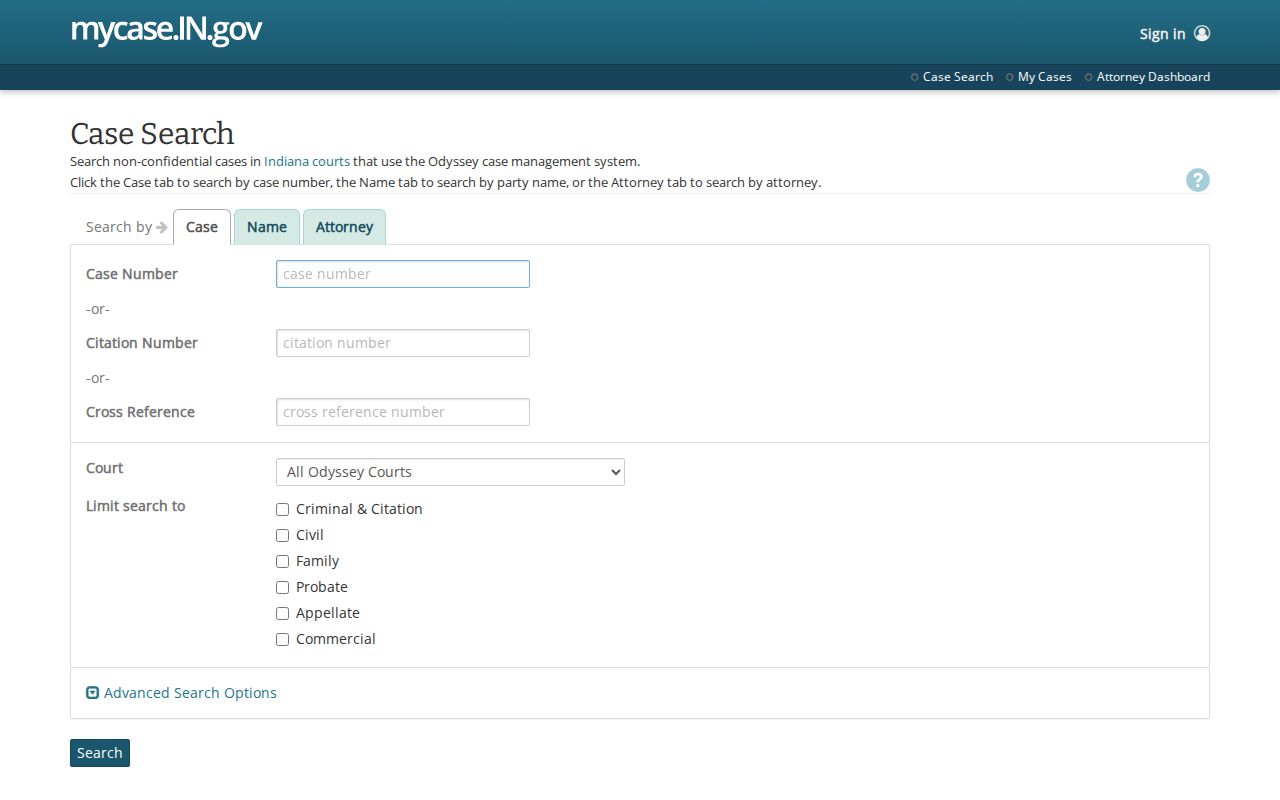
That screen can help you locate a Madison County case. The Clerk still keeps the official court file.
How Madison County Tracks Active Warrants
Madison County publishes no full account of how its active list moves from courtroom to screen. The courts issue process, the Clerk maintains the files, and the Sheriff serves and enforces warrants within its authority. Anderson and Elwood City Courts handle local matters too. Those divided roles explain why no single public display should be asked to certify every warrant type. An agency list can lag behind a new court order, while a docket may omit restricted content or lack a clear warrant label. The Sheriff page warns that updates can take 23 hours, and it gives no complete-list statement or exact refresh time. So a warrant served this morning may still appear. A new warrant may not show yet. Sealed, juvenile, expunged, confidential, or protected material can also stay out of public view under Indiana's court-access rules.
Note: A missing name is not proof of no warrant, and a displayed warrant may lag later service or recall.
Confirm Madison County Warrant Matches
Never rely on an apparent match before checking it. Common names can catch the wrong person, and the public Sheriff interface shows generic demonstration rows rather than validated live entries. Search with identifiers tied to your own matter. A cause number works best, because it connects the docket, court division, orders, bond entries, hearings, and disposition.
- Write down the court, cause or citation number, charge label, and bond detail the official source displays.
- Search the same identifier in MyCase and limit the court to Madison County when possible.
- Call the Madison County Clerk at 765-641-9443 for a Circuit Court file, or contact the named city court.
- For an agency-held record, contact Sheriff Records at 765-646-9290 and follow its request rules.
- Ask the issuing court what current order controls before planning payment, bond, appearance, or surrender.
The official MyCase search tips cover the case, citation, cross-reference, party, date, court, and status fields. The same tips apply to a Madison County case lookup.
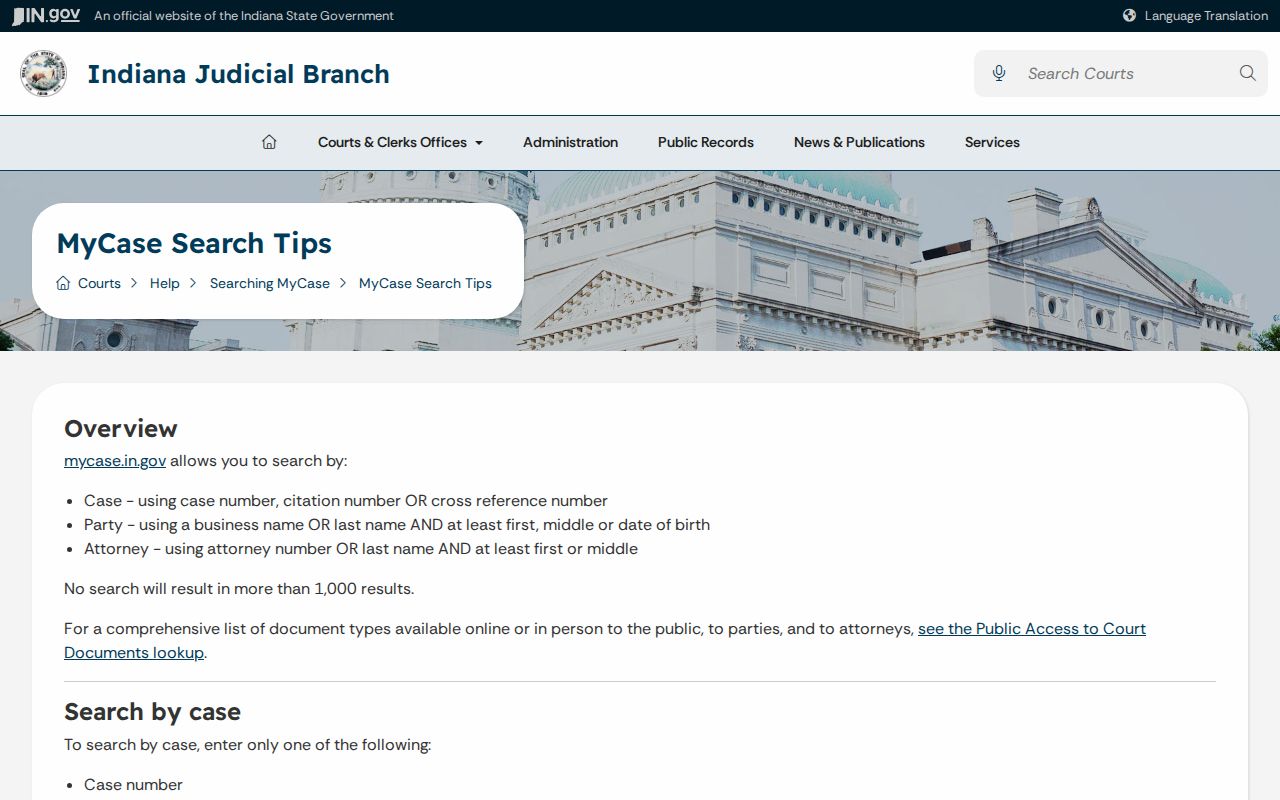
Those controls narrow a search nicely. Only the Clerk or the issuing court can confirm the official Madison County docket and order.
Inside an Active Warrant Record
A warrant record in Madison County rarely holds every fact in one row. The Sheriff page says its expandable details are meant to show charge and bond information. MyCase can display public case events, hearing history, orders, or disposition. The Clerk's file remains the official court record. Because the current display publishes no status dictionary, treat each field that follows as conditional unless the official page itself supplies it.
| Cause or Citation Number | Connects the case, court division, public docket, and related orders when available. |
|---|---|
| Charge or Offense | Describes the associated allegation or case classification, subject to access limits. |
| Issuing Court | Identifies the court that controls recall, hearing, and other judicial action. |
| Bond | May state an amount or type, but the advisory schedule and judicial exceptions still apply. |
| Issue or Event Date | May show when process issued or the event that led to it, if publicly displayed. |
| Service or Status | May show pending, served, returned, or recalled activity; Madison publishes no local code legend. |
A Madison cause number can look like 48C01-2301-L6-0123. That string is only a format example, not a live Madison County case or warrant.
When Madison County Shows No Result
A blank public search does not prove that no warrant exists. The Sheriff list may sit inside its update window, the case may belong to a city court, or the material may be sealed or restricted. Older court records may never have gone online. Federal matters live in a different system entirely. MyCase itself warns that it does not contain every court or older record and is not a complete criminal-history source. Keep asking until a court answers.
Check the custodian: A blank online result should lead to the Clerk, issuing court, or Sheriff Records, not a guess about warrant status.
The Madison County Sheriff's Records Division takes its form by email, fax, or in person. Bring a copy of a state ID. Describe the process type, date range, location, court, and any cause or citation number you know. No warrant-specific response deadline or full fee schedule is posted, so plan on more than same-day service.
Warrant Roundups and Most-Wanted Lists
The Sheriff's homepage runs a Madison County's Most Wanted card. Its Crime Tips page points readers to the county warrant page and a warrant-tip email. Treat the card as a spotlight, not a roster. It is not the full Madison County outstanding-warrant list. Check names, photos, and descriptions only through the official source.
Official source: Use the Madison County Sheriff Crime Tips page for the listed tip route and call 911 only for an emergency.
Madison County publishes no reward amount, roundup calendar, amnesty day, or countywide fee waiver. No update schedule or removal policy appears either. Resolution still starts with the court and the case number. Trust a special event only when the Sheriff, Clerk, Prosecutor, or court posts a dated notice.
Madison County Warrant Court Network
Six divisions make up the Madison County Unified Circuit Court. Local allocation rules assign each case to one of them. Case type and existing supervision drive that routing. Anderson City Court and Elwood City Court instead handle qualifying traffic, misdemeanor, and ordinance matters. The records path does not swap around. The Sheriff serves process, the Clerk keeps the court files, and the issuing judge alone controls a recall or any other order. To route an outstanding-warrant question, start with the official Madison County courts directory. It lays out the public structure of all six divisions.
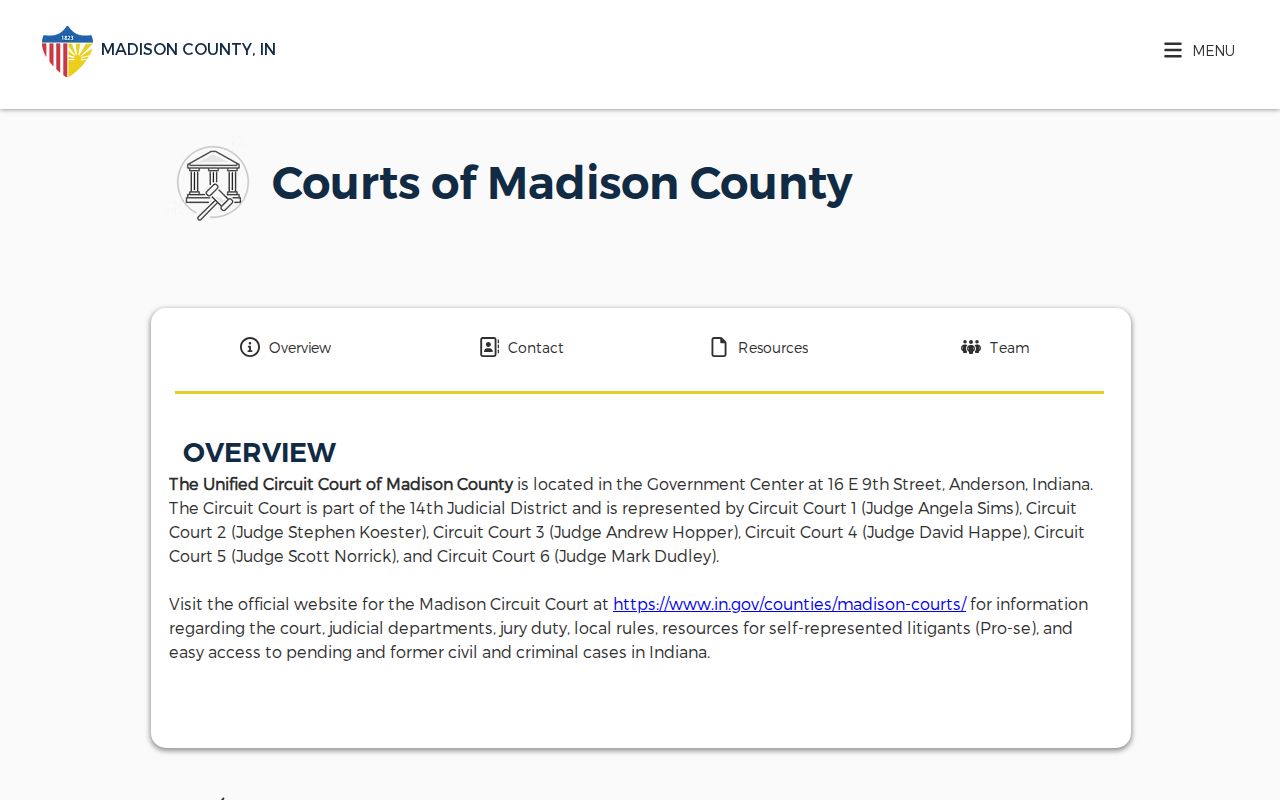
Match the Madison County division to the cause number before you call. Skip the court-by-court sweep. Pendleton ordinance cases need extra care. State rules say the former town court was abolished, and a later interlocal packet routes town ordinance work to Elwood City Court.
Madison County Warrant List Boundaries
Not every record called a warrant belongs on a criminal active list. A traffic failure to appear can involve a city court, the Circuit Court, and a separate BMV consequence. The Indiana Department of Revenue sends tax warrants to the Sheriff Civil Division for collection. A civil writ of body attachment is different again. Madison Local Rule LR48-TR64-23 governs it. Federal warrants belong to the federal court and the U.S. Marshals Service. The offices and remedies differ for each.
- Active warrant
- Process the publishing office still represents as open, subject to update delay and later court action.
- Failure to appear
- Not attending or answering a required court event; Indiana and Madison materials use the term FTA.
- Body attachment
- A civil contempt or show-cause writ that must not be treated as a generic criminal bench warrant.
- Tax warrant
- A Department of Revenue collection matter handled through the Civil Division, not an arrest-warrant list.
That separation keeps you off the wrong payment path. It also stops you from asking one Madison County office to certify another office's records.
When Your Name Is on the Warrant List
First, confirm the entry is yours and still active. Write down the cause number and the issuing court that controls the warrant. Then get legal advice on the safest path. What happens next depends on the order itself. The court may require an appearance, a motion to recall or quash the warrant, bond, proof of compliance, payment, or judicial review. Payment alone does not always end the arrest process. Madison County publishes no universal surrender calendar. Ask the court about a hearing or surrender route. Ask the Jail what identification or release papers apply if the court directs a surrender. The county bond schedule is advisory only. It says some active warrants or extraditable holds need a judicial officer before release, and it names the Clerk, Jail, or Community Correctional Complex as possible bond-posting places depending on the case.
Act carefully: Consult an attorney before surrender, and confirm the current court order, bond terms, location, and required documents with officials.
After the judge acts, get official proof. That means a docket entry, order, or receipt. The Sheriff page may take 23 hours to reflect the change, and for missed appearances the Madison County bench warrant search gives more specific court-routing steps.